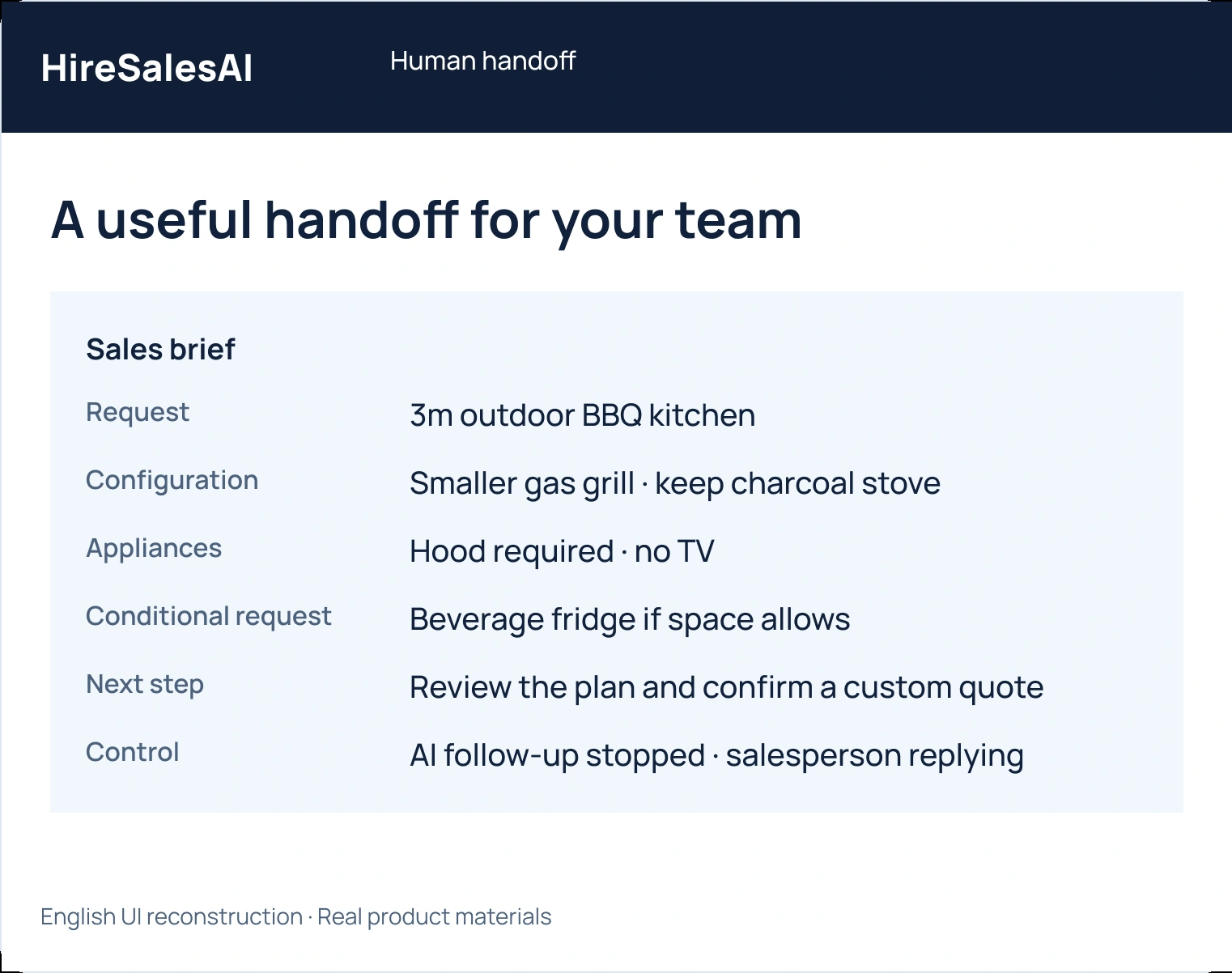
The buyer explains the requirement, asks for a special condition and waits. A second salesperson joins and asks the same questions again. The problem may be the handoff: the conversation was transferred, but the pending decision was not made clear.
This guide is for a small sales-team manager receiving conversations from colleagues or an AI agent. Our six-part summary organizes the decision, rather than replacing access to the authorized conversation history. Respond.io documents assigning conversations with context; the checks below are our proposed acceptance method.
Write the decision before the transcript
Start with the unresolved issue and why it needs this person. “Please review” gives little direction. “Buyer requests a term outside the approved quote; confirm whether the exception is allowed” identifies the task. The summary should make the next action clear without pretending that approval has already been granted.
Attach or link the relevant conversation in the authorized system so the recipient can inspect the evidence. Share only what the role needs. A public website illustration is not an appropriate place for raw buyer chats, private prices or internal knowledge.
Use a six-part handoff summary
- Buyer objective. State the buying task and the context already confirmed. Label assumptions instead of presenting them as facts.
- Confirmed requirements. Record the requested product, specification, quantity, destination and timing that matter for this decision.
- Open issue. Identify the question, objection or exception that remains unresolved. Explain why normal handling cannot complete it.
- Terms and promises. Separate what the seller actually approved, what the buyer requested and what has already been communicated.
- Evidence and uncertainty. Point to the relevant message or catalog record. Note missing stock, specification or authority checks rather than filling them in.
- Owner and next action. Assign the person or team, state the action due and record whether they accepted the handoff. Use a real response window if one exists.
A summary with six parts does not require a long report. Keep it short enough to read before answering the buyer. Include facts that change the decision and keep background details in the linked history. If the recipient cannot identify the open issue quickly, the summary needs work.
A hypothetical special-term request
Suppose a buyer has selected a catalog item and now requests a payment term that is outside the approved offer. This is an illustrative situation, not an actual customer negotiation. A weak handoff says “interested buyer, please close.” It leaves the next salesperson to discover the exception and risks treating interest as approval.
A useful summary states the confirmed item and quantity, the approved payment basis, the different term requested by the buyer and the person responsible for that decision. It also says that the requested term has not been approved. Both summaries concern the same situation; only the second makes the authorization boundary visible.
Define what the AI should do during takeover
A handoff policy should identify who continues the conversation and how duplicate or conflicting replies are avoided. Test the actual configured system rather than assuming that assigning an owner automatically changes every automation. If a buyer asks for a person, the path must reach an available authorized owner or explain the real next response window.
HireSalesAI is designed to progress sales conversations and hand over decisions outside the business's approved rules. The receiving person remains responsible for special pricing, contractual commitments and other exceptions. Confirm the workflow in the deployed configuration before treating it as ready for live operation.
Test whether the handoff is usable
Use three acceptance checks: can the recipient state the pending decision, locate the supporting evidence and identify what has not been approved? If any answer is unclear, repair the summary or routing rule before expanding automation.
Then review actual authorized handoffs for repeated buyer questions, incorrect ownership, conflicting promises and delayed acceptance. Distinguish “sent to a team” from “accepted by a responsible person.” A handoff count alone does not establish that the buyer received a useful response.
Measure continuation rather than transfer volume
Track the time to owner acceptance, whether the pending decision was answered and whether the buyer agreed a next step. Record orders and payments separately, using the actual business evidence. Do not count a transferred conversation as a won deal.
For a small team, a short manual review can reveal missing evidence before a complicated dashboard is available. Use the same checklist for colleague-to-colleague and AI-to-human handoffs, then compare similar cases and record uncertainties. For earlier qualification, see the wholesale buyer qualification guide.
Frequently asked questions
Is the full conversation enough for a good sales handoff?
Keep access to the authorized history, but add a concise summary of the pending decision, confirmed requirements, authority limits and next owner so the recipient can act.
When is an AI-to-human handoff complete?
Distinguish assignment, owner acceptance and a useful buyer response. Use the real configured workflow and business evidence rather than a transfer event alone.
Should special terms requested by a buyer appear in the summary?
Yes, clearly label them as requested and unapproved until an authorized person confirms them. Do not rewrite the request as a promise.
Sources and scope
This guide presents our operating recommendations. Examples are hypothetical. Public source information was checked on 2026-10-11; it is not evidence of a customer outcome.
Discuss your sales workflow
Tell us your product, current inquiry channel and the sales step you want to improve.
Discuss setup on WhatsApp