A new buyer sends a product picture and asks for your best price. There is no quantity, variant or delivery requirement. Your team can reply quickly, but a discount would answer a question whose commercial scope is still unknown.
For a small wholesaler, the useful next step is to make the inquiry quoteable. Use the information already in the conversation, identify the missing detail that affects the offer and ask one focused question. The method below is our proposed sales workflow, illustrated with a hypothetical inquiry.
Identify the item before discussing a discount
Check whether the picture maps to an approved product reference. A similar appearance does not establish the material, size range, packaging or customization. If the item is uncertain, confirm that first. Sending the lowest price from a different catalog item can create an expectation that the actual requested product cannot meet.
HubSpot's sales qualification guide treats budget, needs, decision authority and timing as useful areas to understand. Apply that idea selectively. An opening chat does not need a full qualification interview, and a short price question does not prove that a buyer is either serious or unqualified.
Keep a four-field quote readiness record
- Product scope: the reference, variant and relevant specification the buyer has actually selected.
- Quantity basis: a confirmed quantity or an explicitly labeled scenario that the buyer can evaluate.
- Commercial assumptions: what the approved amount includes and which delivery or customization details still require checking.
- Next decision: the missing input or approval that allows a useful quotation to be issued.
This is an internal record, not four messages to send at once. If the buyer already provided quantity and a reference, retain them. Ask about the remaining requirement rather than restarting the conversation. Explain why the question changes the answer so the buyer can see the value of replying.
Compare responses to the same picture inquiry
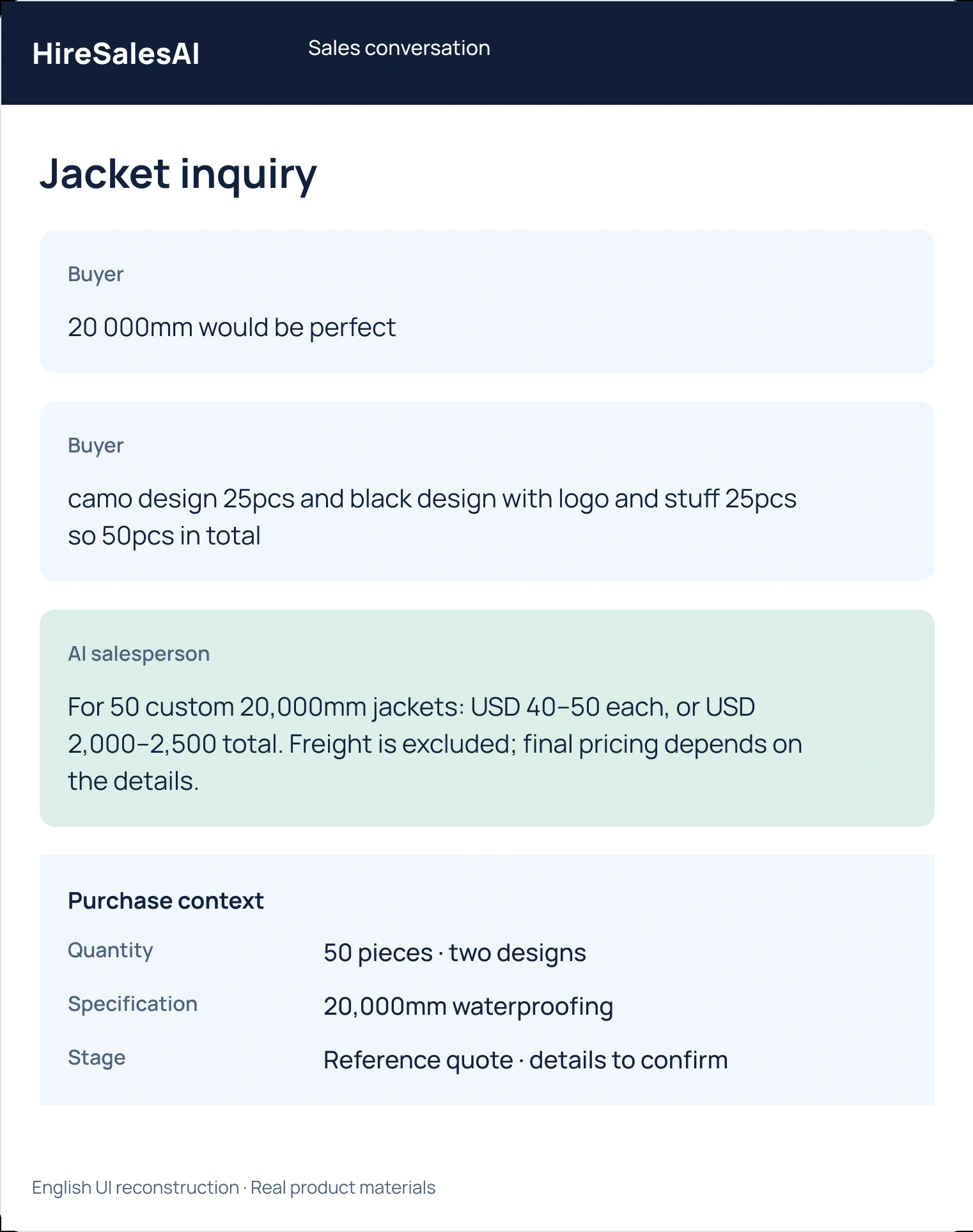
Imagine a hypothetical retailer asking about jackets shown in an approved catalog image. The intended quantity is unknown. A reply announcing a special discount might sound helpful, but it assumes a price basis and authorization that have not been established.
A more useful reply confirms the catalog reference and asks for the expected quantity so the team can check the applicable quotation. If the buyer is still comparing quantities, offer to prepare a defined scenario under your actual approved rules. Do not invent quantity breaks or suggest that a larger order automatically qualifies for a lower price.
Once the buyer confirms 60 pieces in this illustration, keep that scope attached to the offer. A later request for 120 pieces or custom packaging is a changed request requiring review. Compare offers for the same scope; otherwise a lower unit price may hide a different product, packaging choice or shipping assumption.
Give a useful answer when a final quote is not ready
Share an approved published price only with its actual conditions. When the business has no applicable approved amount, explain which check is pending and who owns it. Avoid a vague promise to send the best price later. Establish the next piece of information that moves the inquiry forward.
Keep willingness to share details separate from purchasing outcome. A buyer who has not chosen a quantity may be planning an assortment rather than refusing to buy. If timing becomes the main uncertainty, use the buying-milestone record to understand the decision ahead. Do not repeatedly ask for a payment before there is an agreed offer.
Configure the AI to preserve the quotation basis
HireSalesAI can ask about purchasing requirements, recommend products using approved information and continue a sales conversation. Give it the product references, pricing rules and escalation owner it may use. Unapproved discounts, exceptional terms and unresolved commitments should go to the responsible person.
Review whether the conversation reaches a sufficient quote scope, whether an authorized quotation is delivered and whether the buyer then makes a verified purchase. Count these separately. More replies or longer conversations alone do not demonstrate better qualification. Without readable commercial results, this checklist remains a process to test rather than a proven conversion improvement.
Frequently asked questions
Should I give a discount when the first message asks for my best price?
Use the applicable approved pricing rules after establishing the quotation scope. A short opening request does not authorize a discount or establish quantity.
What if the buyer has not decided how much to order?
Offer a clearly identified quantity scenario if your business can quote it. Keep its assumptions visible and do not present the scenario as a confirmed order.
Can an AI salesperson issue every quote without review?
Only within the information and authority actually configured. Unapproved discounts, exceptional terms and missing commercial inputs require the responsible person.
Sources and scope
This guide presents our operating recommendations. Examples are hypothetical. Public source information was checked on 2026-10-15; it is not evidence of a customer outcome.
Discuss your sales workflow
Tell us your product, current inquiry channel and the sales step you want to improve.
Discuss setup on WhatsApp