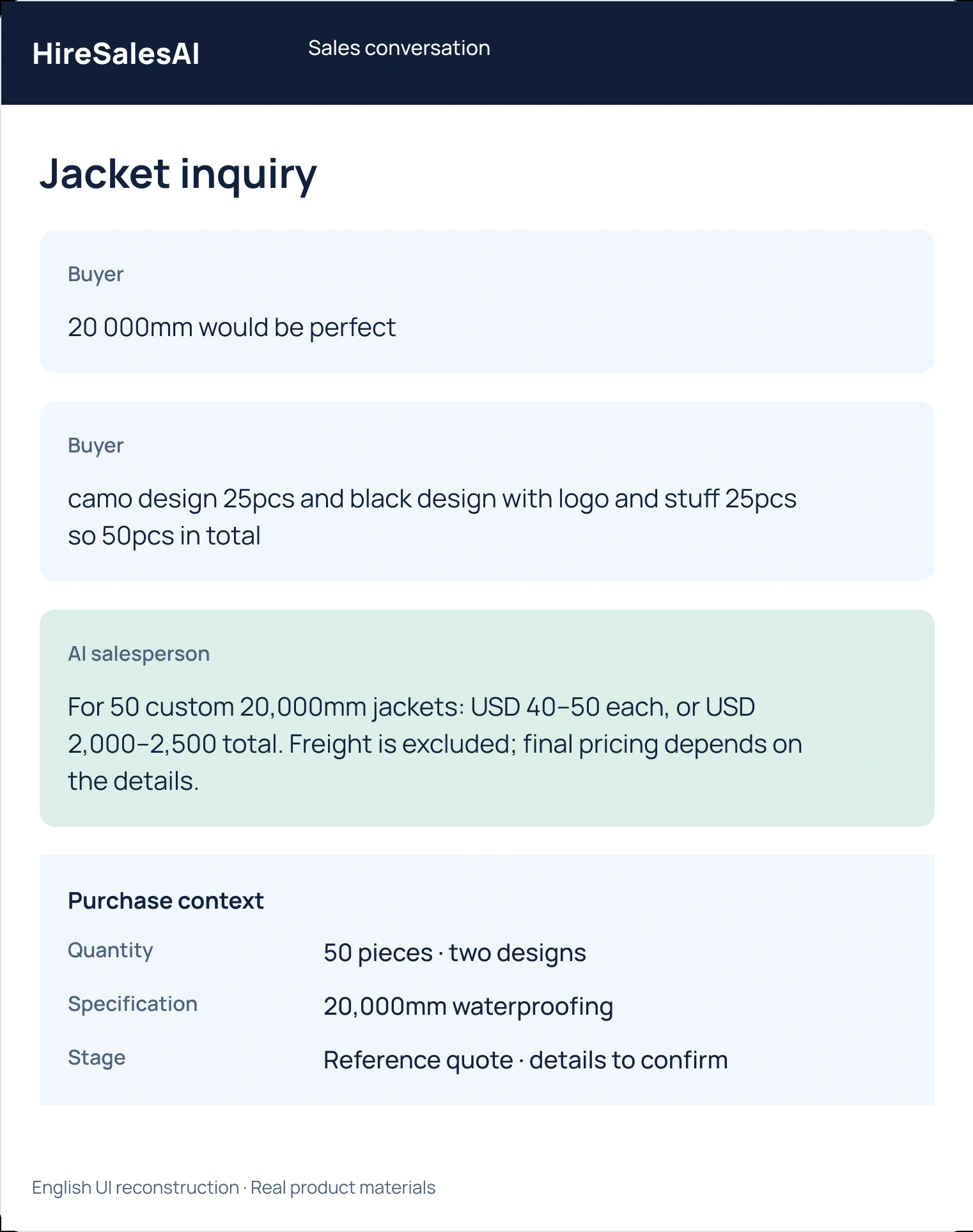
A buyer asks for a smaller opening order. Your salesperson repeats the minimum, and the conversation stops. Another salesperson immediately offers an exception without checking the rules. Both responses skip the question that matters: which quantity constraint is preventing this particular purchase?
This guide is for a wholesale owner handling minimum-order objections. Shopify's B2B documentation distinguishes minimum quantities, increments and volume-pricing rules, including rules that apply per variant. Our three-part diagnostic below adapts that distinction into a sales conversation; it does not prescribe your company's commercial policy.
Make the unit and scope visible
“Minimum order” can refer to units of a specific item, units of each variant, a case-pack increment or a minimum total order value. These conditions are not interchangeable. Retrieve the applicable product and customer terms before explaining them. If the source is unclear, resolve the ambiguity internally rather than guessing.
State the rule in the unit the buyer is using. A minimum of 24 units per color is different from 24 units across all colors. An increment of 12 describes allowed steps, not necessarily the lowest order. An order-value threshold describes money, not units. These numbers illustrate distinctions, not our offered terms.
Diagnose the objection in three parts
- Clarify the binding rule. Which item, variant, pack or total value does the minimum apply to? Identify the policy version and any customer-specific terms already approved.
- Understand the buying constraint. Ask whether the buyer is testing demand, limited by assortment, short of storage or working within an initial budget. Treat the answer as buyer-provided information, not an inferred customer score.
- Select an authorized next step. Explain the available path that addresses the constraint. It may be an approved standard variant, a permitted assortment, an existing sample option or a human review. If none applies, say so clearly.
These are checkpoints, not a mandatory three-message sequence. If the buyer has already explained the budget and the rule is known, focus on the next decision. Do not ask for business details unrelated to evaluating a possible order.
A hypothetical variant comparison
Imagine a catalog rule of 24 units per color, packed in increments of 12. A retailer asks for 12 blue and 12 gray units. This invented example is not a HireSalesAI customer case. The request totals 24 units but does not meet a 24-unit minimum for either color.
Compare two explanations of the same request. “You need 24” leaves the scope ambiguous. “The approved minimum is 24 of each color, with 12-unit increments” explains the actual constraint. The seller can then ask whether one color suits the buyer's first test. That option is useful only if the buyer agrees and the applicable terms allow it.
Do not invent a mixed-color exception to keep the conversation moving. If such an exception needs approval, record the requested mix and the buyer's reason, then route it to the person authorized to decide. A request for review is not an accepted order.
Explain the tradeoff without inventing a cost story
If your business has a verified reason for a minimum, explain it in plain language. Do not claim a factory setup cost, shipping limit or packaging restriction just because it sounds plausible. Buyers should be able to distinguish an actual requirement from a salesperson's explanation.
Keep the minimum separate from price breaks. Reaching a permitted quantity does not automatically qualify for a better unit price. Quote the currently authorized tier and clarify any missing conditions. If the buyer requests a concession, preserve the existing terms until a person approves a change.
Configure an AI sales agent with explicit rules
Provide the product reference, rule scope, units, increment, approved pricing and exception owner. HireSalesAI can clarify the buyer's needs, explain approved terms and continue objection handling. It should not change a minimum, authorize a special discount or claim availability from an old conversation.
Check the actual workflow using one valid quantity, one invalid variant mix, a request for a sample and an exception requiring a person. The test succeeds when the answers match the approved records and route the unresolved decision correctly. That is a configuration check, not proof of improved conversion.
Measure clarified decisions
Record whether the rule was understood, whether an approved alternative was considered, whether an exception was requested and whether an order was independently confirmed. Keep unreadable results unknown. Compare similar products and buyer stages rather than treating every low-quantity request as a poor lead.
For related decisions, see our wholesale buyer qualification guide and sample-to-bulk decision checklist.
Frequently asked questions
Can a buyer combine colors to meet an MOQ?
Only if the applicable policy allows it. A minimum per variant and a total-order minimum can produce different answers.
Is a case-pack increment the same as an MOQ?
No. The minimum is the lowest allowed quantity; an increment controls allowed quantity steps. Confirm both from the approved policy.
Should a small opening order automatically be rejected?
Clarify the buyer’s purpose and the applicable rules. Consider only authorized options; escalate an exception instead of changing policy yourself.
Sources and scope
This guide presents our operating recommendations. Examples are hypothetical. Public source information was checked on 2026-10-12; it is not evidence of a customer outcome.
Discuss your sales workflow
Tell us your product, current inquiry channel and the sales step you want to improve.
Discuss setup on WhatsApp